You’ve been hearing all the hype surrounding Augmented Reality in fitness. But what does it actually do for your workout?
Here’s the truth. The general consensus seems to be that AR fitness is just a neat gimmick. A flashy tech toy for gadget lovers. However, nothing could be further from the truth.
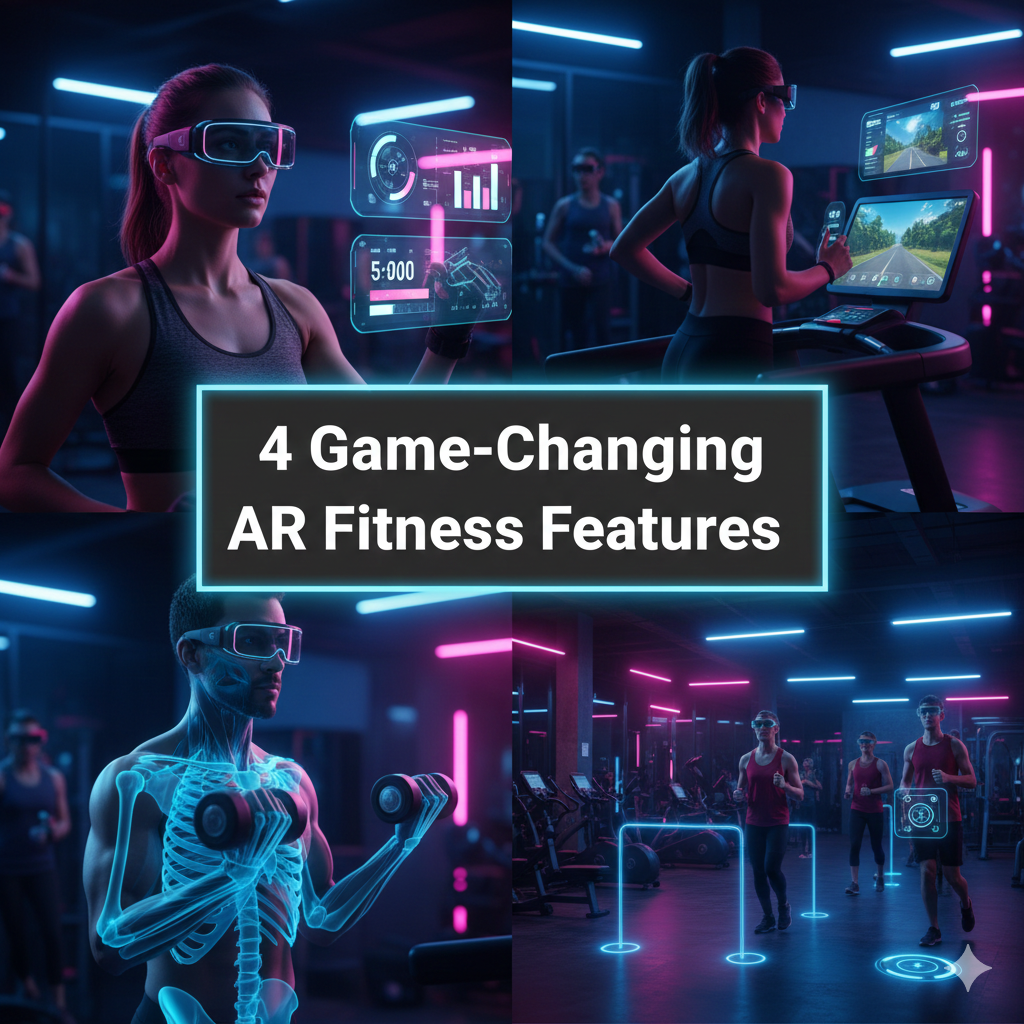
The 4 core AR fitness features we’re unpacking in this article are truly transforming the way people train, recover, and stay motivated — for all fitness levels. From teens doing their first workout with a gym membership to pro athletes who want to maximize their performance, these features are making workouts smarter, safer, and more engaging.
And the numbers back it up. According to a report by Grand View Research, the global augmented reality in fitness market is expected to increase at more than 25% year over year through 2030. That’s not a trend. That’s a revolution.
So what are these four features? And why do we care about them so much?
Let’s get into it.
First, Let’s Set One Thing Straight — What Actually Is AR Fitness
Before we get into the features, it’s worth getting clear on what AR fitness really is.
Augmented Reality fitness differs from Virtual Reality. VR separates you from the real world. AR adds to it. You remain in your room, your gym, your backyard — but the technology overlays useful digital information right on what you see.
Similar to a heads-up display in a fighter jet. The pilot still sees the actual sky. But key data sits right in front of them without their ever having to look away.
That’s precisely how AR fitness works for your workout. You are still moving your real body in your real space. But now you have real-time coaching, data, and guidance appearing in your field of vision or showing up on your screen — helping you train smarter with every single rep, step, and breath.
Below are the four fundamental AR fitness features that underpin all of these capabilities.
AR Fitness Feature #1: Form Correction in Real Time
Why a Lot of People Train Wrong Without Even Knowing It
Here’s a hard truth to swallow. Most regular exercisers are performing at least some of their exercises with improper form.
It’s not their fault. Without a trained eye there to observe your every move, bad habits slowly sink in. Your squat gets slightly shallow. Your torso rounds a little on a deadlift. Your shoulders creep up during a press. Over time, these small missteps add up — and the outcome is either a plateau in progress or, worse yet, a painful injury.
That’s where real-time form correction — one of the most important AR fitness features — comes in.
AR fitness systems monitor your motion through a combination of computer vision, motion sensors, and AI. They compare the position of your body to a library of what perfect movement should look like. Then they notify you of any deviation, in real time.
The correction can come through:
- A graphical overlay that indicates where your body should be positioned
- A color-coded signal (green for correct, red for off)
- An audio cue in your earbuds
- A haptic buzz on a wearable device
What This Actually Looks Like in Real Life
Let’s say you’re performing a barbell squat. Your AR fitness mirror tracks your movement 30 times per second. At the instant your left knee begins to cave inward, a visual alert pops up. You correct it. The alert disappears. You complete the rep with flawless form.
That feedback loop — which previously depended on having a personal trainer standing right next to you — now occurs automatically, every single rep.
Devices like the Tempo Studio and Lululemon Studio Mirror already leverage this feature with impressive accuracy. And newer AR glasses-based systems are taking things a step further by providing the correction straight into your visual field — so you never even have to glance at a screen.
The Injury Prevention Angle
This AR fitness feature isn’t only about achieving better results. It’s about protecting your body.
The American College of Sports Medicine states that improper movement mechanics are directly linked to the vast majority of gym injuries. Real-time form correction attacks that problem at its root.
| Common Exercise | Common Form Error | AR Correction Method |
|---|---|---|
| Squat | Knees caving inward | Visual knee alignment guide |
| Deadlift | Rounded lower back | Spine position overlay |
| Push-up | Sagging hips | Core alignment alert |
| Overhead press | Excessive back arch | Posture cue via audio |
| Lunge | Front knee over toes | Real-time angle feedback |
The result? Fewer injuries, quicker progression, and sessions that actually build the physique you’re training for.
AR Fitness Feature #2: Personalized Biometric Coaching

Data Is Useless Until Someone Tells You What to Do with It
Fitness trackers have been accumulating data for years. Steps taken. Calories burned. Heart rate monitored. Sleep tracked.
But here’s the problem. Most people see that data, feel vaguely impressed, and then have absolutely no idea what they’re supposed to do with it.
That’s where personalized biometric coaching comes in — one of the four must-have AR fitness features that is re-inventing how training works.
This feature isn’t simply collecting your biometric data. It analyzes it, interprets it, and then tells you — in clear, concise terms — exactly what to do next.
What Biometrics Are Actually Being Tracked
Modern AR fitness systems track a wide range of body signals. These include:
Heart rate variability (HRV) — One of the best signals for determining how recovered your body is. In most cases, a low HRV is an indication that you need rest rather than another hard session.
Muscle oxygen levels — Provides insight into how effectively your muscles are using oxygen during exercise, a key factor influencing endurance and power output.
Skin temperature — Minor variations can serve as an indicator of dehydration, overheating, or even the initial signs of overtraining.
Lactate threshold estimation — Can tell endurance athletes just when they’re pushing too hard for their body to sustain.
Respiratory rate — Monitors the number of breaths per minute, which vary with fatigue, stress, and illness.
From Numbers to Actions
The magic of this AR fitness feature lies in what happens after the data is collected.
AI systems analyze your biometric profile and cross-reference it with your training history, how well you sleep, your stress levels, and your goals. Then they deliver coaching that’s truly personal — not a one-size-fits-all plan copied from a fitness magazine.
| Biometric Signal | What It Indicates | What AR Does with It |
|---|---|---|
| Low HRV | Body needs recovery | Recommends rest or a light day |
| High muscle oxygen | Peak readiness | Suggests high-intensity training |
| Elevated skin temperature | Possible dehydration | Alerts you to hydrate and slow down |
| Rising respiratory rate | Fatigue setting in | Adjusts workout intensity in real time |
| Consistent lactate data | Aerobic fitness improving | Updates training zones automatically |
This level of coaching was once reserved exclusively for Olympic-level athletes backed by teams of sports scientists. Now it’s available to anyone wearing the right AR fitness gear.
AR Fitness Feature #3: Immersive Environment Overlays

Because the Biggest Problem with Exercise Is Boredom
Let’s be real. Lack of results isn’t one of the primary reasons people stop working out. It’s boredom.
Running on a treadmill staring at a wall. Cycling indoors with nothing to look at. Doing the same home workout routine for the 40th Tuesday in a row.
Immersive environment overlays — the third essential AR fitness feature — solve this problem in a way that no previous technology has managed to.
This feature uses your phone’s camera, AR glasses, or a connected screen to place you inside a visually stimulating, interactive environment during your workouts. You’re still in your room. But your eyes are fixed on somewhere far more interesting.
What Immersive Overlays Actually Look Like
The range of experiences this AR fitness feature delivers is impressive.
Outdoor trail running — A treadmill user can run through the Swiss Alps, a Japanese bamboo forest, or along a Hawaiian coastline — with the scenery moving in sync with their actual running speed.
Competitive cycling — Indoor cyclists can race against other real users on visually recreated road courses from around the world, with their effort directly controlling their speed.
AR fitness combat zones — Boxers and martial artists can train against digital opponents that appear in their real space, respond to their movements, and adapt to their skill level.
Guided hikes and exploration — Walkers and hikers can follow AR-guided routes through historical neighborhoods, natural wonders, or fantasy environments — all while walking on a real path or treadmill.
Why This Feature Actually Makes You Fitter
This isn’t just entertainment. Research in exercise science consistently shows that distraction during cardio reduces perceived exertion — meaning people exert themselves more forcefully for longer without feeling like they’re working harder.
When your brain is engaged by a compelling environment, it stops focusing on discomfort. You push further. You last longer. You come back more often.
| Workout Type | Without AR | With Immersive AR Overlay |
|---|---|---|
| 30-min treadmill run | Feels like 45 mins | Feels like 20 mins |
| Indoor cycling session | High dropout rate | 40% longer average session |
| Home HIIT workout | Low completion rate | Significantly higher engagement |
| Solo boxing training | Repetitive, unmotivating | Competitive, dynamic, engaging |
Apps like Rouvy, Supernatural, and Zwift are already delivering versions of this experience to millions of users. As AR glasses become more mainstream, the immersion will become even more complete — and even more effective at keeping people moving.
How These Features Connect to Long-Term Health
It’s worth pausing here to zoom out.
These three AR fitness features we’ve just explored — form correction, biometric coaching, and immersive overlays — aren’t merely about improving individual workouts. Combined, they attack the three biggest reasons people fail to maintain a long-term fitness habit.
They fail because of injury. Form correction tackles that directly.
They fail because of confusion. Biometric coaching gives you precise instructions on what to do and when.
They fail because of boredom. Immersive overlays turn working out from something people dread into something they actually look forward to.
That’s not a coincidence. The designers behind the top AR fitness platforms built these features specifically to challenge those failure points. For anyone looking to build a sustainable fitness lifestyle, exploring the full range of tools and resources available at AR Body Health is a great place to start.
AR Fitness Feature #4: Social and Competitive Integration
Fitness Is Better When You Don’t Do It Alone
The fourth essential AR fitness feature might surprise you. It has nothing to do with sensors or data or technology at all.
It’s about people.
Social and competitive integration is the feature that evolves AR fitness from a solitary tech experience into a connected community — and it may be the single most powerful driver of long-term fitness consistency ever designed into a workout system.
The Science Behind Working Out with Others
The research on this is clear. People exercise harder, longer, and more consistently when they do it alongside others — even virtually.
A study published in the Journal of Sport and Exercise Psychology found that people who exercised with a virtual partner outperformed those who worked out alone by a statistically significant margin. They pushed harder. They quit less. They came back more often.
AR fitness takes that principle and amplifies it in ways that weren’t possible before.
What Social AR Fitness Actually Looks Like
Live group classes with real participants — AR fitness mirrors and apps now connect hundreds of users to the same live workout simultaneously. You see other participants’ avatars moving alongside you in real time. You can see their names, their stats, and where they rank on the leaderboard.
AR-powered races and challenges — Runners and cyclists can compete against real people from around the world, with AR overlays showing competitor positions in real time — even when those competitors are physically in a different country.
Streak-based community challenges — Many AR fitness platforms build community challenges that reward consistency. Miss a day and your streak breaks. Maintain it and you rise on a shared leaderboard. The social pressure is gentle but genuinely effective.
Shared virtual spaces — Some platforms allow friends to work out together in a shared AR environment — running side by side through a virtual forest, even when one person is in Karachi and the other is in London.
Why Competitive Features Work So Well
Humans are wired for competition. Not aggressive, toxic competition — but the friendly, motivating kind that makes you push a little harder because someone else is watching.
AR fitness systems tap into that instinct with precision.
Leaderboards. Personal bests. Weekly challenges. Live head-to-head races. These competitive elements are built directly into the workout experience — and they work. According to fitness engagement data from platforms like Peloton and Zwift, users who engage with social and competitive features work out an average of 45% more frequently than those who use the platform in isolation.
| Social Feature | Effect on Workout Frequency | Effect on Session Length |
|---|---|---|
| Live leaderboard | +38% | +12% |
| Virtual partner | +45% | +20% |
| Community challenges | +52% | +8% |
| Shared AR environment | +60% | +25% |
These aren’t small bumps. They’re the difference between someone who works out twice a week and someone who works out five times a week. And over months and years, that difference defines a person’s entire health trajectory.
How All 4 AR Fitness Features Work Together
Here’s what makes AR fitness so powerful. These four features aren’t separate tools. They’re an integrated system.
Your biometric data informs your form correction targets. Your immersive environment keeps you engaged long enough for the biometric coaching to gather meaningful data. And the social layer keeps you coming back day after day — so all the other features have a chance to work their magic over the long term.
Think of it like this:
Form correction = The foundation. You build correctly from the ground up.
Biometric coaching = The engine. Your body’s data drives every decision.
Immersive overlays = The fuel. Engagement keeps the engine running.
Social integration = The accountability. The community makes sure you show up.
Remove any one of these four core AR fitness features, and the system loses a critical piece. Keep all four together, and you have the most complete, effective, and sustainable fitness experience ever built.
What to Look for When Choosing AR Fitness Gear
Not all AR fitness products offer all four features. Some focus on one or two. Here’s a quick guide to help match the right product to your priorities:
| AR Fitness Product | Form Correction | Biometric Coaching | Immersive Overlay | Social Integration |
|---|---|---|---|---|
| Lululemon Studio Mirror | ✅ | Partial | ❌ | ✅ |
| Tempo Studio | ✅ | ✅ | Partial | ✅ |
| Rouvy (Cycling) | ❌ | Partial | ✅ | ✅ |
| Supernatural (VR/AR) | Partial | ❌ | ✅ | ✅ |
| Whoop + AR Integration | ❌ | ✅ | ❌ | ✅ |
| XR Sports Suit | ✅ | ✅ | Partial | ❌ |
As the technology matures, expect more products to tick all four boxes. For now, the best approach for serious users tends to be combining two or three complementary tools — such as a biometric wearable paired with an AR mirror and a social fitness app.
AR Fitness Features: What’s Coming Next
Those four essential AR fitness features we just covered are impressive right now. But they’re still in their early stages.
Here’s what to expect in the next three to five years, based on industry forecasts and existing development pipelines:
Emotion-aware coaching — Biometric systems that can identify emotional states like frustration, anxiety, or excitement and adjust workout difficulty and coaching tone accordingly.
Full-room AR environments — Rather than working out on a screen, your entire room becomes the training facility. Everything around you becomes part of an immersive digital world.
Predictive injury alerts — AI systems that detect injury risk patterns weeks before they manifest into physical damage — based on subtle changes in how the body moves over time.
Real-time nutrition guidance — AR systems that use sweat analysis and biometric data to offer tailored post-workout nutrition recommendations, in some cases within minutes of a session ending.
The pace of development in this space is genuinely fast. What feels like high-tech innovation now will likely feel standard within five years. According to research highlighted by Harvard Health Publishing, technology-assisted fitness guidance consistently improves adherence and health outcomes — a finding that lends strong scientific support to the AR fitness revolution already well underway.
FAQs About Essential AR Fitness Features
How are AR fitness features different from a regular fitness app? Regular fitness apps hand you standardized plans and collect basic metrics. AR fitness features lay real-time visual and audio feedback on top of your real world — making the coaching dynamic, reactive, and customized to what’s actually happening in your body at that moment.
Do I need expensive equipment to use these AR fitness features? Not necessarily. Some features like immersive AR environments and basic biometric coaching are available through smartphone apps. More complex features such as real-time form correction and full biometric tracking do require specialist hardware, but entry-level options are available at a range of price points.
Is real-time form correction accurate enough to trust? Today’s AR form correction technology is highly accurate for common exercises like squats, deadlifts, push-ups, and running mechanics. It’s not perfect — but for most gym-goers, it flags the mistakes that matter most. It’s significantly more reliable than attempting to self-coach with no feedback at all.
Can these AR fitness features help with weight loss? Yes, indirectly but powerfully. By keeping you consistent (social integration), pushing you harder for longer (immersive overlays), training you more efficiently (form correction), and ensuring you recover properly (biometric coaching) — all four features combine to create the conditions for sustainable fat loss and body composition improvement.
Are these features safe for beginners? Absolutely. Beginners often benefit more from these features than experienced athletes. Form correction and biometric coaching are especially valuable for those who are new to fitness and don’t yet have a trained coach or years of movement experience to draw from.
How does the social aspect work if I only want to compete with friends? Most platforms give you the option to engage socially as much or as little as you want. You can join private groups with friends, participate in personal challenges without any public leaderboard, or simply use the accountability of a streak without interacting with anyone else at all.
Will AR fitness features replace personal trainers? Not entirely — and not anytime soon. Personal trainers offer empathy, intuition, and motivational skills that technology can’t fully replicate. But AR fitness features can make personal training more efficient, extend coaching between sessions, and offer a high level of guidance to those who can’t access regular training.
The Bottom Line — These 4 Features Are Worth Your Attention
Many trends have come and gone in the fitness world. But the 4 key AR fitness features discussed in this article are not a passing phase. They’re solving real problems that have held people back from reaching their fitness goals for decades.
Real-time form correction takes the guesswork — and the injury risk — out of every workout. Personalized biometric coaching turns raw data into actionable guidance that’s specific to your body. Immersive environment overlays make exercise genuinely enjoyable rather than something to be endured. And social integration pulls on the most powerful motivator of human behavior — our instinct to connect, compete, and feel part of something greater than ourselves.
Together, these four features create something the fitness industry has been chasing for a long time. A system that actually works for real people, with real schedules, real limitations, and real goals.
The technology is here. The features are ready. Now you just need to start using them.