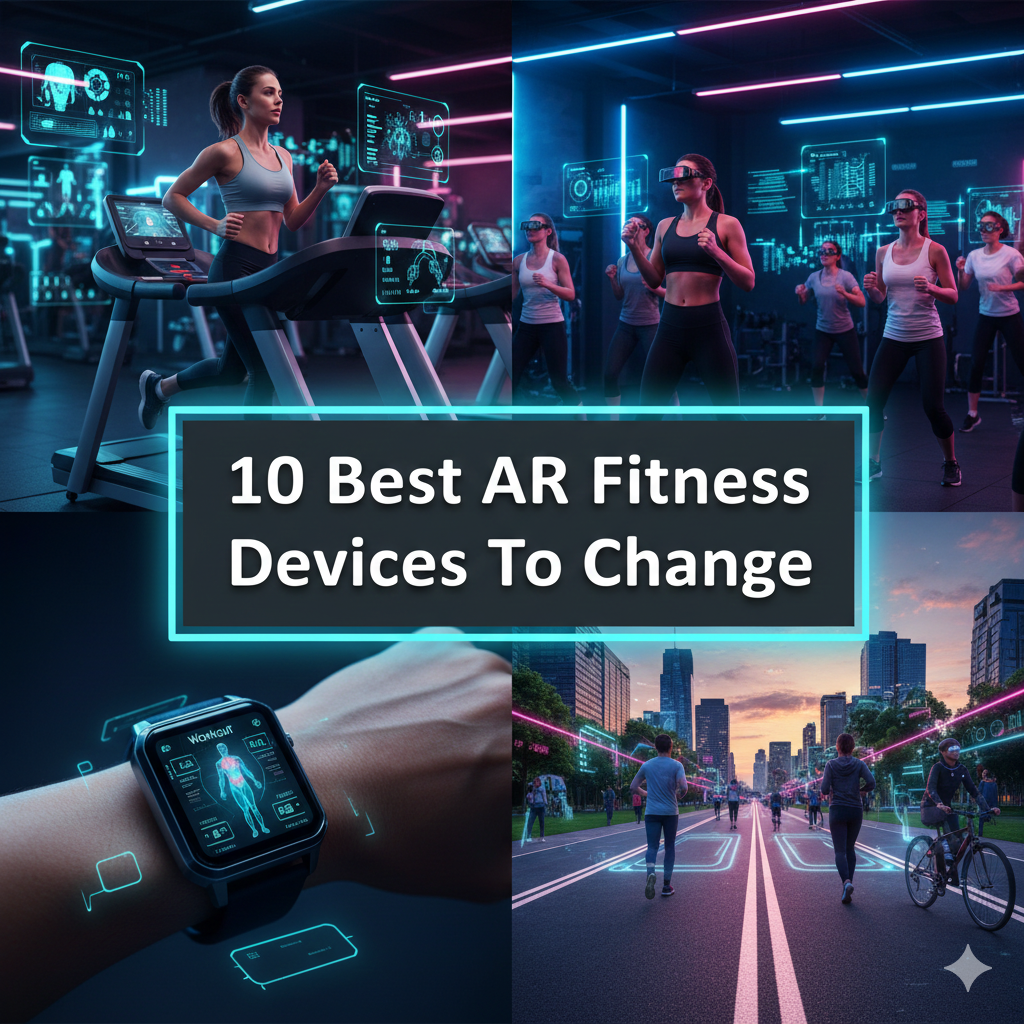
Put on your glasses, and suddenly your living room becomes a boxing ring. Or strapping on a wristband that displays your muscle data hovering above you like a hologram. Almost sounds like a sci-fi movie, no?
It’s not. It’s happening right now.
AR fitness devices — gadgets that employ augmented reality to integrate digital information into the real world — are surging in popularity. They are transforming bland workouts into entertainment experiences. They’re helping athletes train smarter. And they’re making fitness downright exciting for people who typically loathe the gym.
Even if you’re not a serious athlete, or just trying to get off the couch, there is an AR fitness device being designed for you. In this article, we’re going to highlight 10 of the most powerful ones available (or set to arrive soon) and tell you exactly what makes each one worth your attention.
Let’s get into it.
AR Fitness Devices: What Are They and Why Should You Care?
Now, before we get into the list, let’s address something quickly.
Augmented reality is not to be confused with virtual reality. VR immerses you in an entirely artificial world. AR overlays digital stuff — numbers, animations, guidance arrows, stats — over the real world you see before you. You can still see your gym, your living room, or the place you run. AR simply adds additional information on top of it.
AR fitness devices leverage this technology to provide you with real-time feedback, tips, and encouragement throughout your workout sessions. Think of it like having a personal trainer and a data scientist working jointly — while you work out.
Why does this matter? Because a majority of folks quit fitness programs because they are boring, too confusing, or the results take far too long to show. AR fitness devices solve all three problems in one.
How Augmented Reality Fitness Devices Really Work
Most AR fitness devices use a mixture of:
- Cameras and sensors to monitor your body movements
- AI software to track what you are doing in real time
- Screens or projections to display data, corrections, or virtual environments
- Haptic feedback (vibrations) to signal when something is in need of fixing
Some of them are worn on the face (smart glasses). Others rest on your wrist, your chest, or are embedded in mirrors and screens. The objective never changes: provide you with better data while you are exercising so that you can improve more quickly.
| Feature | Traditional Workout | AR-Enhanced Workout |
|---|---|---|
| Feedback | After the workout (if you’re lucky) | Real-time, instant |
| Motivation | Self-driven | Interactive and gamified |
| Data Tracking | Basic (steps, heart rate) | Deep (muscle activation, joint angle, load) |
| Coaching | Have to pay for someone | Built-in |
| Engagement | Often low | Consistently high |
10 Must-Know AR Fitness Devices
1. WHOOP 4.0 with AR Integration Features
The savvy recovery tracker gets even savvier.
The WHOOP 4.0 began as a recovery and performance band worn on the wrist. But its newer software updates stretch into AR territory, through companion apps that overlay your biometric data on top of live views.
It continuously monitors your heart rate variability, sleep quality, strain, and recovery score. The AR-connected edition allows you to see what your body is prepared to do even before you hit the gym.
What makes it powerful:
- Health monitoring around the clock without screen distraction
- In-app coaching driven by AI
- Connects to AR glasses for real-time training feedback
Best for: Serious athletes, endurance runners, and anyone looking to optimize recovery.
WHOOP doesn’t simply say “You should work out harder.” It lets you know when your body is truly prepared to push — and that significant difference helps in long-term outcomes.
2. Myo Gesture Control Armband (Next-Gen Version)
Control your workout with a simple flex of the arm.
The Myo armband reads the electrical signals in your muscles and converts them into digital commands. The latest iteration is in the works for use with AR headsets, allowing users to control on-screen workout dashboards just by moving their hands or fingers.
Imagine stopping your workout timer with a snap of your finger, or scrolling through your exercise plan with the flick of your wrist — all without touching any screen.
What makes it powerful:
- Actual muscle signals read by EMG (electromyography) sensors
- Zero-touch interaction with AR interfaces
- Can be used during strength training sessions without interruption
Best for: Tech-forward gym-goers and anyone who hates stopping mid-workout to tap a screen.
3. HTC VIVE Focus with Fitness AR Modes
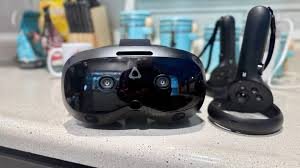
Not just a headset — a complete AR fitness experience.
The HTC VIVE Focus series has introduced mixed reality modes that merge the real world with guided AR exercise environments. You will see your real floor while a virtual trainer guides you through a high-intensity workout.
It’s not pure VR — you can still see your surroundings, making it safer and more practical for home workouts.
What makes it powerful:
- Passthrough camera shows you your actual surroundings while supplementing with digital guides
- Dozens of AR fitness apps available on the VIVE platform
- Full-body motion tracking
Best for: Home fitness enthusiasts who want a high-end, immersive experience without stepping out the door.
4. Form Swim Goggles
The only AR fitness device built for the pool.
It is one of the most unique AR fitness devices out there. Form Swim Goggles are standard-shaped swim goggles housing a mini heads-up display within the lens. While you’re swimming laps, you’ll see your pace, stroke rate, distance, and split times floating right before your eyes.
No more pausing at the wall to look at your watch. Say goodbye to wondering whether you’re on pace.
What makes it powerful:
- Real-time in-lens AR display during swimming
- Auto-detects stroke type (freestyle, breaststroke, backstroke, butterfly)
- Connects to Apple Watch and Garmin
- Water-resistant up to 10 meters
Best for: Competitive swimmers, triathletes, or anyone who trains seriously in the water.
| Form Swim Goggles Specs | Details |
|---|---|
| Display Type | Monocular AR heads-up display |
| Metrics Shown | Pace, stroke rate, distance, calories, split time |
| Battery Life | 16 hours |
| Connectivity | Bluetooth, Apple Health, Garmin |
| Price Range | $199–$229 |
The Form Swim Goggles are currently available to purchase, and many competitive swimmers around the globe have declared they’re game-changers. This is AR fitness that really, truly works in a demanding sport environment.
5. Amazfit Falcon with AR Companion App
Designed for extreme athletes, perfected with AR guidance.
Amazfit Falcon is a premium smartwatch designed for high-performance training. Its companion AR app allows your phone’s camera to layer training metrics and route guidance on top of the real-life path or trail you’re running.
You can point your phone at a hill and get real-time elevation data, optimal pacing zones, and effort recommendations — all overlaid on your live camera view.
What makes it powerful:
- Military-grade durability with dual-band GPS
- AR-powered route navigation for trail runners and hikers
- Advanced health metrics including VO2 Max and recovery time
Best for: Trail runners, hikers, and outdoor athletes who train in unpredictable terrain.
6. Tonal Smart Home Gym with AR Coaching Overlay
Strength training finally gets a brain.
Tonal is a wall-mounted smart gym that uses digital weight resistance. Its newer software updates overlay AR coaching information on the screen to show where your body placement should be, how low your squat should go, and whether your back is aligned correctly.
It’s like having a personal trainer beside you, correcting your form as you go. If you’re serious about training smarter and want to learn more about body health and performance, AR Body Health is a great resource to explore alongside tools like Tonal.
What makes it powerful:
- AI + AR combined for real-time form correction
- Digital resistance up to 200 lbs — automatically adjusts based on your performance
- Tracks over 50 body metrics per session
- AR coaching that learns your movement patterns over time
Best for: Home gym users who want pro-level strength coaching — minus the coach.
Price point: Roughly $3,495 for the device (monthly membership required for AR coaching features)
It’s an investment. But for serious lifters looking to build strength the right way, Tonal’s AR coaching can save you from developing bad habits and getting injured over the years.
7. Vuzix Blade AR Smart Glasses for Athletic Training
AR glasses that don’t fall off your face when you’re working out.
The Vuzix Blade smart glasses have been around for years in industrial applications. Now fitness app developers are creating workout overlays specifically designed for them. While you’re running, cycling, or lifting weights, you can see your heart rate, cadence, power output, and coaching cues — all directly in your line of sight.
They look like regular sunglasses — not like glasses from a sci-fi movie — so you can wear them outdoors without drawing too much attention.
What makes it powerful:
- Heads-up AR display built into a sleek glasses frame
- Compatible with iOS and Android
- Supports third-party fitness apps
- Clear optical visibility outdoors in direct sunlight
Best for: Runners, cyclists, and outdoor athletes who prefer data without having to glance at a watch or phone.
8. Mirror (Now Lululemon Studio) with AR Workout Guidance
Your reflection becomes your trainer.
The Mirror is a full-length smart mirror that displays interactive workout classes. Its newer AR features superimpose position guides and movement targets directly onto your reflection. So you can do the workout and, simultaneously, see where your body needs to be.
It’s a rather eye-catching AR fitness experience in terms of home gym setups.
What makes it powerful:
- See yourself + AR movement guides overlaid simultaneously
- Live and on-demand classes across 50+ fitness categories
- Personal training sessions conducted through the screen
- Heart rate integration for real-time intensity feedback
Best for: People who like to work out at home but who also want the structure and motivation that comes with a class environment.
| Device | AR Feature | Price Range | Best For |
|---|---|---|---|
| Form Swim Goggles | In-lens swim metrics | $199–$229 | Swimmers |
| Tonal | Form correction overlay | $3,495+ | Strength training |
| Mirror (Lululemon Studio) | Reflection + movement guides | $1,495+ | Home cardio/yoga |
| Vuzix Blade | Heads-up display | $799+ | Outdoor athletes |
| HTC VIVE Focus | Full mixed reality | $1,299+ | Home fitness |
9. Arctis Nova Pro Headset with Fitness AR Sound Coaching
Your ears are your new trainer.
This one’s a bit different. AR doesn’t have to be visual. Audio AR — also known as spatial audio coaching — uses sound to steer your workout through three-dimensional space. Pair the Arctis Nova Pro headset with fitness AI apps and they’ll provide real-time audio cues that sound as if a trainer is standing right next to you.
“Straighten your back.” “Speed up your cadence.” “You have 30 seconds — push it.”
Newer AR fitness apps are creating entire spatial audio coaching systems that deliver perfectly timed instructions via headsets like these, using your location, heart rate, and movement data.
What makes it powerful:
- Spatial audio creates the feeling of being surrounded by your coach
- Active noise cancellation allows you to really zero in
- Connects with fitness AI apps for personalized voice coaching
- Light enough to wear through a heavy cardio session
Best for: Runners, cyclists, and anyone who finds visual AR distracting but still wants guided coaching.
10. Apple Vision Pro with Fitness AR Applications
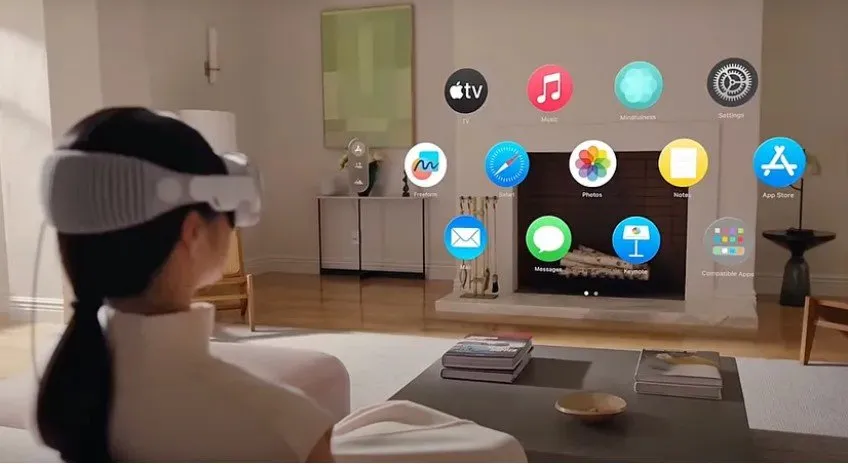
The world’s most powerful AR fitness platform — and we’re only warming up.
Apple Vision Pro is Apple’s mixed reality headset, and while it isn’t specifically marketed as a fitness device, the fitness apps being built for it are going to be extraordinary.
Apps like “Fitness+” in spatial mode allow you to view your workout instructor life-size in your living room. Movement tracking software draws joint angle guides on your body. And because Vision Pro is powered by some of Apple’s most advanced sensors, it can track even very subtle details of your movement.
This is still early days. But the potential of AR fitness on Vision Pro is larger than any other platform right now.
What makes it powerful:
- Eye tracking, hand tracking, and full-body motion detection
- Life-size AR workout instructors in your living room
- Integrates with Apple Health for deep biometric data
- Very high-resolution display for clear AR overlays
Best for: Tech early adopters and serious fitness enthusiasts who want to invest in cutting-edge technology.
Price: Starts at $3,499
It’s expensive. But Vision Pro is where all AR fitness devices are eventually headed — and the apps being built for it right now are already impressive.
The Real Benefits of Using AR Fitness Devices
People frequently ask: “Do I really need one of these?” Fair question.
Here’s what the research and early user data suggest about AR fitness devices:
Better form, fewer injuries. When you can see real-time corrections, you fix bad habits before they turn into injuries. This is especially valuable for weightlifters and runners.
Higher motivation. Gamification and immersive environments encourage people to keep coming back. Research on VR exercise shows workout sessions tend to feel shorter and more enjoyable, leading to better consistency.
Smarter training decisions. Metrics like HRV, muscle activation, and recovery scores eliminate the guesswork in your training. You do less overtraining and undertraining, and hit the sweet spot more often.
Accessible coaching. A human personal trainer charges $50–$150 per hour. AR fitness devices provide the same — sometimes better — feedback at a fraction of the ongoing cost.
Things to Think About Before You Buy
AR fitness devices are a thrill — but they’re not perfect yet. Here are a few things worth knowing:
Battery life is still an issue. The majority of AR headsets last two to three hours. That’s plenty for a workout, but barely.
Price is a real barrier. The best devices run hundreds or even thousands of dollars. Budget options exist, but those usually sacrifice important features.
Not all sports are covered yet. Swimming (Form Goggles) and running are well served. Team sports and martial arts still have limited AR options.
Comfort matters. Wearing a headset during HIIT is very different from wearing one at a desk. Seek out reviews written by athletes, not just tech reviewers.
FAQs About AR Fitness Devices
Q: Are AR fitness devices safe to use during strenuous workouts? Most AR fitness devices are built for active use. Devices like Form Swim Goggles and Vuzix Blade are tested for durability. Full headsets like Vision Pro, however, are more suited for lower-intensity workouts because of their size and weight.
Q: Can AR fitness devices replace a personal trainer? For many people they can supplement or substitute for a trainer. AR devices are great for form correction, motivation, and data tracking. But for nuanced, relationship-based coaching, human trainers still have an edge — at least for now.
Q: Do I need a smartphone to use AR fitness devices? It depends on the device. Some (like Form Swim Goggles) are stand-alone. Others (like the AR features of Amazfit Falcon) need a companion smartphone app. Always check compatibility before purchasing.
Q: Are there AR fitness devices suitable for beginners? Yes. Mirror (Lululemon Studio) and Tonal are both welcoming to beginners and provide step-by-step guidance, so you don’t need prior fitness or tech experience.
Q: Do AR fitness devices work outdoors? Some are made specifically for outdoor use, such as Vuzix Blade and Amazfit Falcon. Others, such as Tonal and Mirror, are designed only for indoor workouts.
Q: How long do AR fitness devices last before needing replacement? If used regularly, most premium devices are built to last 3–5 years. Software updates frequently add new features, extending the useful life of the hardware.
Q: Will I have to pay a monthly fee for AR fitness features? Many devices charge a subscription for their AI coaching and AR content. Tonal charges around $49/month. Lululemon Studio charges $39/month. WHOOP also runs on a membership model. Keep this in mind when budgeting.
Wrapping It All Up
AR fitness devices are no gimmick. They’re a real advancement in the way humans train, recover, and stay motivated.
From Form Swim Goggles tracking your laps in real time, to Apple Vision Pro placing a life-size trainer in your living room — these 10 AR fitness devices show just how far the technology has come. And this is only the tip of the iceberg.
The devices gaining the most traction right now are the ones that address real problems: bad form, lack of motivation, costly coaching, and confusing data. The best AR fitness devices do all of that — and make working out genuinely fun in the process.
If you are considering integrating an AR fitness device into your routine, begin by focusing on your most pressing pain point. Hate pausing mid-swim to check your pace? Form Swim Goggles. Struggling with strength training form? Tonal. Looking for the full premium AR experience? Apple Vision Pro.
This is what the future of fitness looks like. You might as well train in it.